Carnegie Hall and Columbus Circle on a NYC Bus Tour: The Two Last Uptown Stops, Hall Tours and How Long to Hop Off
By the BusTourNYC editorial team · Published · Updated
Which NYC hop-on hop-off stops are closest to Carnegie Hall and Columbus Circle?
Big Bus New York's Uptown Loop has a stop at each. Stop 18, Columbus Circle, is at the southwest corner of Central Park beside the circle, and Stop 19, Carnegie Hall, is at Seventh Avenue and West 57th Street in front of Trattoria Dell'Arte, across the street from the hall. They are the last two stops of the Uptown Loop, which runs a 75-minute circuit every 60 minutes; the first bus reaches Columbus Circle at 11:02 a.m. and Carnegie Hall at 11:07 a.m. per Big Bus's timetable. Carnegie Hall's own one-hour tour is the only way to see the main auditorium without a concert ticket, and it runs on limited weekday and Saturday times that the hall posts a week ahead. Plan about 90 minutes for the hall tour plus the Columbus Circle area.
Where the two stops are and how they connect
Columbus Circle is Stop 18 and Carnegie Hall is Stop 19 on Big Bus's Uptown (Blue) Loop. They're about two and a half blocks apart, so you can hop off at one and walk to the other.
Big Bus New York's Uptown Loop, which the company also calls the Blue Route, starts at Stop 14, Hope Sculpture, at Seventh Avenue and West 53rd Street. It runs down to One Times Square and Rockefeller Center, up Fifth Avenue to the Metropolitan Museum of Art, back down past the Central Park Zoo, and then west along the bottom of the park. The last two stops on that circuit are the two this guide covers: Stop 18, Columbus Circle, and Stop 19, Carnegie Hall.
The timetable places the Columbus Circle stop at Central Park and Columbus Circle, on the southwest corner of the park next to the main monument. Look for the bus stand on the park side of the circle, where the Maine Monument and the Merchants' Gate entrance face the traffic island; holiday markets and street closures can shift it, so check the operator's live map on the day. The Carnegie Hall stop is at Seventh Avenue and West 57th Street, in front of Trattoria Dell'Arte. The hall stands on the opposite corner, at 881 Seventh Avenue.
Between the two is a short walk: east along Central Park South or West 58th Street to Seventh Avenue, then south a block to 57th. Because the stops are so close, most riders treat them as one hop-off and walk between them, rather than waiting for the next hourly bus to cover a few hundred yards.
- Stop 18, Columbus Circle: Central Park & Columbus Circle, southwest corner of the park, next to the main monument (Big Bus timetable).
- Stop 19, Carnegie Hall: 7th Ave & W 57th St, in front of Trattoria Dell'Arte (Big Bus timetable).
- Carnegie Hall's address: 881 Seventh Avenue at West 57th Street. Tours leave from the Box Office lobby.
- Subway backup: 59 St–Columbus Circle (A, B, C, D, 1) and 57 St–7 Av (N, Q, R, W).
Timing the hop-off around an hourly loop
Uptown buses pass Columbus Circle at about two minutes past each hour from 11:02 a.m. to 5:02 p.m., and Carnegie Hall five minutes later. Line up a Carnegie Hall tour time first, then pick the bus that arrives before it.
Big Bus publishes the Uptown Loop as a 75-minute circuit leaving every 60 minutes, with departures from Hope Sculpture between 10:00 a.m. and 4:00 p.m. The first bus reaches Columbus Circle at 11:02 a.m. and Carnegie Hall at 11:07 a.m. The last listed bus at Columbus Circle is 5:02 p.m. Because the Uptown Loop runs only once an hour, a missed bus here costs you an hour, not 15 minutes. Most visitors at this end of town finish on foot or by subway rather than wait.
Carnegie Hall's public tours are the fixed point. The hall says walk-in tours may be offered Monday through Friday at 11:30 a.m., 12:30 p.m. and 1:30 p.m., and on Saturday at 11:30 a.m. and 12:30 p.m., when the hall's rehearsal and performance schedule allows. The 11:07 a.m. bus gets you to the box office in time for an 11:30 tour. If you're riding from the Met, its stop at Fifth Avenue and East 83rd Street sees its first bus at 10:45 a.m., so staying on from the Met gets you to Carnegie Hall about 20 minutes later.
Downtown Loop riders don't need the Uptown bus at all. The Downtown Loop's Stop 1, M&M's World, is at Seventh Avenue and West 48th Street, nine blocks south of Carnegie Hall on the same avenue. That's a straight walk up Seventh Avenue past the theaters north of Times Square. The Downtown Loop runs every 30 minutes, which makes it the easier bus to plan around if Carnegie Hall is your only uptown stop.
The official Carnegie Hall tour: what you see and the rules
A one-hour guided tour covering Stern Auditorium / Perelman Stage, the Composers' Gallery and the Rose Museum. Tickets are limited to 8 per tour time, and roller bags and large backpacks aren't allowed in the auditorium.
Carnegie Hall describes its public tour as a one-hour walk with a guide through more than 130 years of the hall's history, including how its acoustics work. The tour page says the tour is the only way to see the main hall, Stern Auditorium / Perelman Stage, without attending a concert. The route also includes rare musical scores in the Composers' Gallery and a stop in the Rose Museum, which holds hundreds of artifacts from the hall's past.
Tours don't run on a fixed year-round calendar. The hall posts tour times as they become available, adding the following week's slots every Thursday afternoon or Friday morning, and it can cancel a tour if a rehearsal or performance needs the stage. You can buy tickets online, by phone through CarnegieCharge at 212-247-7800, or in person at the Box Office at 57th Street and Seventh Avenue. There's a limit of 8 tickets per tour time, and online and phone orders carry a convenience fee. Advance tickets can be picked up at the Box Office from 11 a.m. on the tour day. We don't print ticket prices because they're set by the hall and can change; check the tour page before you go.
The bag rules matter more on a bus day than most visitors expect. Carnegie Hall says there's no bag, coat or stroller check during normal tour hours, and roller bags, large suitcases and bulky backpacks aren't permitted inside Stern Auditorium on tours. These items must be stored offsite. If you're riding the bus on the day you check out of your hotel, leave luggage at the hotel or a storage service first. The hall says all tours are wheelchair accessible, wheelchairs are available on request, and assistive listening devices are lent against a valid ID.
If you hold a New York Pass, the pass's own listing for the Carnegie Hall tour says you show the pass at the Box Office and join the next available tour, first come, first served, with limited spaces and no large groups. Our pass comparison explains which sightseeing passes include a bus and which don't.
- Length: about one hour, with a guide (Carnegie Hall tour page).
- Includes: Stern Auditorium / Perelman Stage, Composers' Gallery, Rose Museum.
- Possible walk-in times: Mon–Fri 11:30 a.m., 12:30 p.m., 1:30 p.m.; Sat 11:30 a.m., 12:30 p.m. Subject to the hall's schedule.
- Limit 8 tickets per tour time. Pick up advance tickets at the Box Office from 11 a.m.
- No bag, coat or stroller check. Roller bags, large suitcases and bulky backpacks aren't allowed in the auditorium.
No tour slot? The free Rose Museum and the lobby
The Rose Museum, on the second floor at 154 West 57th Street, is free and open Monday through Saturday from 11 a.m. to 4:30 p.m. You can see it and the lobby without a ticket.
Tour slots sell out, and some weeks the hall's schedule leaves few public tours. The Rose Museum is the fallback. Carnegie Hall's shop page lists it at 154 West 57th Street, second floor, open Monday through Saturday from 11 a.m. to 4:30 p.m., and before concerts and during intermissions of events in Stern Auditorium. NYC Tourism describes it as free, with scores, letters, photographs and other artifacts from the artists who have performed there, and notes that it closes for a period each late summer.
A visit to the museum and gift shop takes 20 to 30 minutes, which fits neatly into a single hop-off if you're also going to walk the circle and the edge of the park. The New York Pass listing makes the same point: you can walk into the lobby and the Rose Museum without a ticket, but you need a concert or a tour to see inside the auditorium.
If you'd rather hear the hall than tour it, check the concert calendar for the evening of your bus day. The last Uptown bus passes in late afternoon, so an evening concert means getting back to your hotel on foot, by subway or by taxi, not on the bus.
Columbus Circle: what you're looking at
A traffic circle at Broadway, Eighth Avenue, Central Park West and 59th Street, built around a 76-foot monument to Christopher Columbus dedicated in 1892. Official distances from New York City are measured from this point.
Columbus Circle is older than its statue. NYC Parks quotes the Central Park commissioners reporting in 1869 that the open circular place had been laid out at the meeting of 59th Street, Eighth Avenue and Broadway as a turnabout for horse-drawn vehicles. The Central Park Conservancy says Olmsted and Vaux's original plan for the park included traffic circles at both southern corners because they were major entrances.
The monument in the middle was dedicated on October 12, 1892, the 400th anniversary of Columbus's first landing in the Americas. NYC Parks' monument record lists it as the work of the Italian sculptor Gaetano Russo, 76 feet tall in total, with a 13-foot Carrara marble figure on a granite column and bronze ships' prows and reliefs. It was donated by Italian Americans led by Carlo Barsotti, publisher of Il Progresso Italo Americano. Below the statue, a winged figure examining a globe represents the Genius of Discovery. The fountains around the base date from 1965.
The Public Art Fund, which once built a temporary living room around the statue's head so visitors could see it up close, notes that the monument marks the point from which all official distances from New York City are measured. That's a good fact to have in mind when the bus swings around the circle. Across the roadway at the park entrance stands the Maine Monument of 1912 to 1913, on the park side of the circle where the bus pulls in.
Pairing the stops with Central Park and the rest of the loop
Columbus Circle is the easiest bus-stop entrance to Central Park's southwest corner, and Strawberry Fields is about 13 blocks north along Central Park West. The Met and MoMA are on the same loop.
From the Columbus Circle stop, you're steps from the park. Walk in through the Merchants' Gate and the paths lead into the park's southern end. Our Central Park guide explains which part of the park each bus stop reaches and how long a light walk takes. If you want Strawberry Fields, the John Lennon memorial near the West 72nd Street entrance, it's about 13 blocks north along Central Park West. That's a walk, not a bus ride, because the Uptown Loop doesn't travel up Central Park West.
A workable Uptown day: take the morning bus to the Met, spend a couple of hours there, ride on past the Central Park Zoo and get off at Columbus Circle. Walk the circle and the corner of the park, then cross to Carnegie Hall for an afternoon tour slot or the Rose Museum. On weekdays the 1:30 p.m. tour is the latest listed public time. If modern art is a higher priority than the Met, MoMA's entrance on West 53rd Street is a short walk from the Hope Sculpture stop where the loop restarts.
If you're deciding whether to buy the Uptown Loop at all, these two stops are part of the case for it. They sit on the stretch of Midtown that the Downtown Loop doesn't reach, and they put a free museum, a landmark concert hall and the park's best-known corner within a few minutes of each other. Compare both loops before you buy, because the Downtown Loop alone gets you no closer than Seventh Avenue and 48th Street.
Compare current tour pricing
Prices and availability change by channel — check both before you book.
Frequently asked questions
Is there a hop-on hop-off stop at Carnegie Hall?
Yes. Big Bus New York's Uptown Loop Stop 19, Carnegie Hall, is at Seventh Avenue and West 57th Street in front of Trattoria Dell'Arte, across the street from the hall. The first bus reaches it at 11:07 a.m., per Big Bus's timetable.
Where is the Columbus Circle bus stop?
Uptown Loop Stop 18 is at Central Park and Columbus Circle, on the southwest corner of the park, next to the main monument, per Big Bus's timetable. Buses pass hourly from 11:02 a.m. to 5:02 p.m.
Can you go inside Carnegie Hall without a concert ticket?
Yes, two ways. The one-hour guided tour is the only way to see Stern Auditorium / Perelman Stage without a concert, and the Rose Museum and lobby are open without a ticket. The museum is open Monday through Saturday from 11 a.m. to 4:30 p.m.
What time are Carnegie Hall tours?
When available, walk-in tours may run Monday through Friday at 11:30 a.m., 12:30 p.m. and 1:30 p.m., and Saturday at 11:30 a.m. and 12:30 p.m. The hall adds the following week's times every Thursday afternoon or Friday morning, and tours can be canceled for rehearsals.
Can I bring luggage on a Carnegie Hall tour?
No. Carnegie Hall says there's no bag, coat or stroller check, and roller bags, large suitcases and bulky backpacks aren't permitted inside Stern Auditorium on tours. Store them offsite before you come.
Does a bus tour ticket include the Carnegie Hall tour?
No. A hop-on hop-off ticket covers the bus and its commentary. Carnegie Hall tour tickets are sold by the hall. The New York Pass lists the tour as an included attraction, with entry on a first-come basis.
How long should I spend at Columbus Circle and Carnegie Hall?
About 90 minutes for the hour-long hall tour plus a walk around the circle and the corner of Central Park. Without a tour, 30 to 45 minutes covers the Rose Museum, the monument and a look into the park.
Sources
- Big Bus Tours — Uptown Loop (Blue Route) timetable: 75-minute tour every 60 minutes; Stop 18 Columbus Circle first bus 11:02, last bus 17:02; Stop 19 Carnegie Hall, 7th Ave & W 57th St, first bus 11:07 (checked Nov 15, 2026)
- Big Bus Tours — Downtown Loop (Red Route) timetable: every 30 minutes; Stop 1 M&M's World, 7th Ave & W 48th St (checked Nov 15, 2026)
- Carnegie Hall — Tours (one-hour tour, Stern Auditorium / Perelman Stage, Composers' Gallery, Rose Museum; walk-in times; 8-ticket limit; bag policy; accessibility)
- Carnegie Hall Shop — Rose Museum and Gift Shop, 154 West 57th Street, second floor, Monday–Saturday 11 AM–4:30 PM
- NYC Tourism — The Rose Museum at Carnegie Hall (free; closes annually in late summer)
- The New York Pass — Carnegie Hall Tour (show pass at Box Office; first come, first served; lobby and Rose Museum open without a ticket; nearby subway stations)
- NYC Parks — Columbus Monument (Gaetano Russo; dedicated October 12, 1892; 76 feet; Carrara marble, granite, bronze; donors)
- NYC Parks — Central Park Highlights: Columbus Circle (1869 turnabout; 1892 dedication; Genius of Discovery; 1965 fountains; Maine Monument 1912–13)
- Public Art Fund — Discovering Columbus (the point from which all official distances from New York City are measured)
- Central Park Conservancy — Columbus Circle (Olmsted and Vaux traffic circles at the park's southern corners)
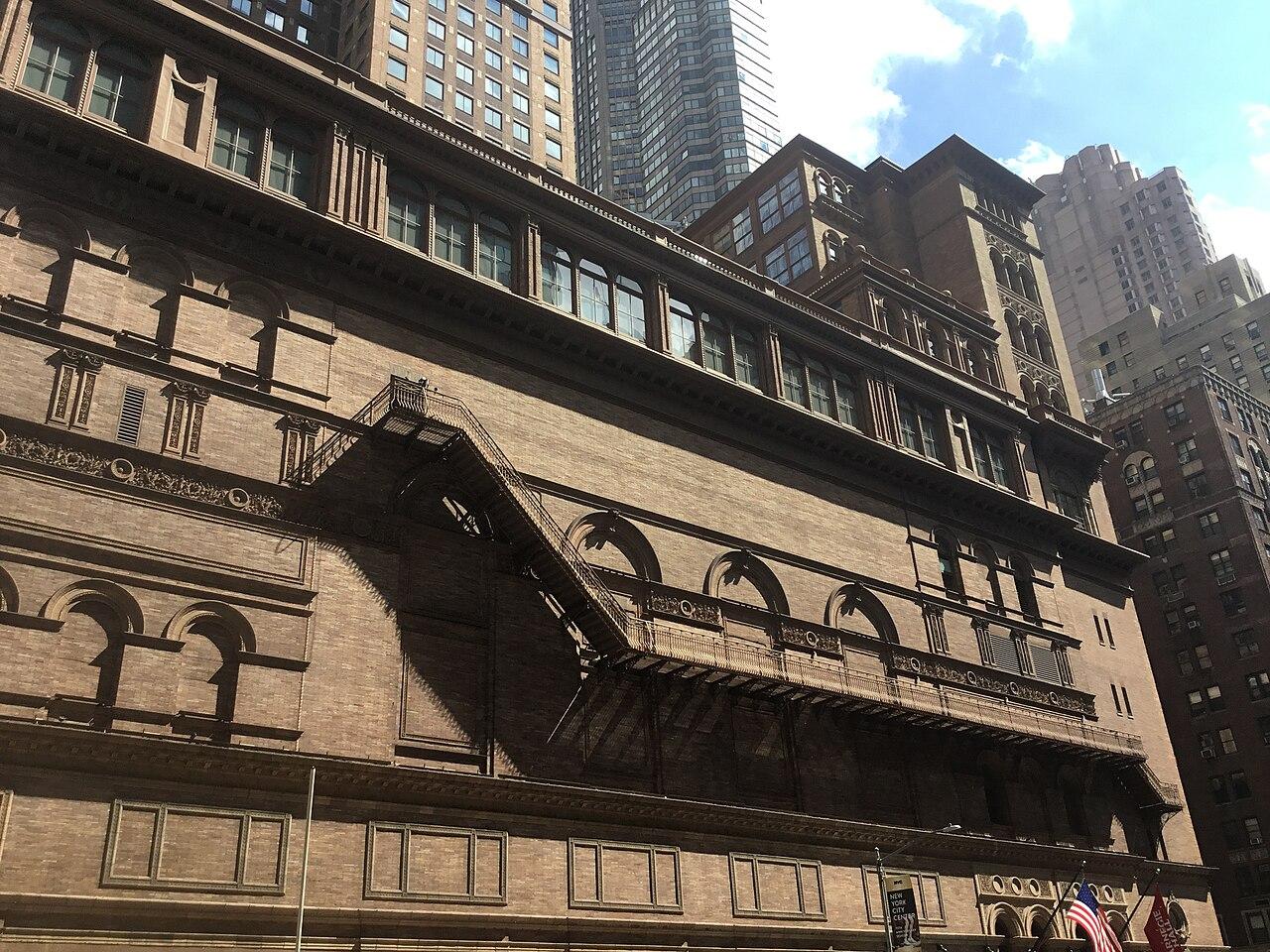
- Photo: "Carnegie Hall August 2021" by Kidfly182, CC BY-SA 4.0, via Wikimedia Commons (resized)
Related guides
Central Park & NYC Bus Tours: What's Actually Included
No — the Uptown loop runs along the park's edges, on streets like Central Park West and Fifth Avenue and the cross streets at 59th and 110th, rather than through the park's interior. You'll see the tree line and stone walls from your seat, but reaching the lawns, the Zoo, or Bethesda Fountain means hopping off and walking in on foot.
The Met & NYC Bus Tours: Which Stop, What It Costs, and How to Time It
Yes, as a hop-off. Big Bus New York's Uptown Loop has a stop on Fifth Avenue at East 83rd Street, right outside the museum, but the bus ticket never covers entry. Met admission is a separate ticket ($30 for adults as of our October 2026 check, pay-what-you-wish for New York State residents). The bigger planning issue is timing: the uptown loop runs hourly and its last bus passes the Met stop before the museum closes, so decide in advance how you'll get back.
Downtown Loop vs. Uptown Loop: Which NYC Bus Tour Route to Ride First
Ride Downtown first if this is your first visit — it covers the landmark corridor most first-timers came for: Times Square, the Empire State Building area, SoHo, Chinatown and Lower Manhattan. Ride Uptown first only if Central Park, the Upper West Side and Museum Mile are the actual reason for your trip. Most multi-day tickets include both loops, so the real question is sequencing, not choosing.
New York CityPASS vs. New York Pass: Which One Actually Gets You a Bus Tour
New York Pass includes hop-on hop-off bus access as one of its 100-plus attractions, because it's built as a time-based pass you use as much as you want within a set number of days. New York CityPASS does not include a bus tour — it's a fixed bundle of five attractions chosen from a list of ten museums, decks, and landmarks, and a sightseeing bus simply isn't one of the ten options. If riding a bus is the point, New York Pass is the one built for that; if your trip is a short list of specific big-ticket sights, CityPASS is a tighter, simpler product.
Get guides like this by email
Occasional, substantial, unsubscribe anytime.