SoHo on a NYC Bus Tour: The Stop, the Cast-Iron Blocks Worth Walking, and How Long to Hop Off
By the BusTourNYC editorial team · Published · Updated
Does the hop-on hop-off bus stop in SoHo?
Yes. Big Bus New York's Downtown Loop has a SoHo stop, Stop 5, at Broadway and Spring Street, between the Flatiron District stop and Chinatown / Little Italy. Hoptripo's stop guide, checked October 5, 2026, lists the cast-iron shopping blocks of Broadway, Prince Street and Greene Street within a few minutes' walk, with the Prince St (R, W) and Spring St (6) subways about 2 minutes away. SoHo is an outdoor architecture-and-shopping stop with no ticketed headline attraction, so 60 to 90 minutes is enough for most visitors; shoppers can easily spend longer.
Where the bus stops and what's within a few minutes
Stop 5, SoHo, is on Broadway at Spring Street. Hoptripo lists the cast-iron blocks of Broadway, Prince Street and Greene Street as the nearby sights, with Little Italy's Mulberry Street about 5 minutes east.
Big Bus New York's Downtown Loop runs south from Times Square through Midtown, past the Empire State Building and the Flatiron District, then down Broadway into SoHo. Stop 5 is labeled SoHo and sits at Broadway and Spring Street. Hoptripo, an independent guide that checked the Big Bus stop list on October 5, 2026, describes what's around it in one line: the cast-iron shopping blocks of Broadway, Prince Street and Greene Street.
That's an accurate summary of what SoHo offers a bus-tour visitor. There's no observation deck, no ticket line and no single building you have to see inside. The neighborhood is the attraction: block after block of 19th-century commercial buildings with ornate iron fronts, now filled with shops, galleries and restaurants. You step off the bus and you're already in it.
For transit, Hoptripo lists the Prince St station on the R and W lines and the Spring St station on the 6 train, each about 2 minutes from the stop. Both get you back to Midtown quickly if the bus is running behind or you decide to stay into the evening.
Stop positions move with construction, street events and parades, so check the operator's live map on the day you ride. Our guide to where to board NYC hop-on hop-off buses explains how the Midtown boarding points feed the rest of the Downtown Loop.
- Stop: Big Bus Downtown Loop Stop 5, SoHo, Broadway and Spring St.
- Before it: Stop 4, Flatiron District. After it: Stop 6, Chinatown / Little Italy.
- Nearby (Hoptripo): the cast-iron blocks of Broadway, Prince St and Greene St; Mulberry St about 5 minutes east.
- Subway: Prince St (R, W) and Spring St (6), each about 2 minutes.
Why SoHo looks the way it does: the cast-iron district in five minutes
The Landmarks Preservation Commission designated the SoHo-Cast Iron Historic District on August 14, 1973. Its report describes 26 blocks and about 500 buildings, many with facades or storefronts made of cast iron, a 19th-century building technology that let merchants put up ornate, large-windowed fronts quickly.
The Commission's 1973 designation report draws the district's boundaries at Canal Street to the south, Houston Street to the north, West Broadway to the west and a line along Crosby Street to the east, and counts 26 city blocks with about 500 buildings. The New York Preservation Archive Project notes that the Commission approved an extension of the district in 2010. In practical terms, almost everything you'll see on a walk from the bus stop is inside a protected historic district.
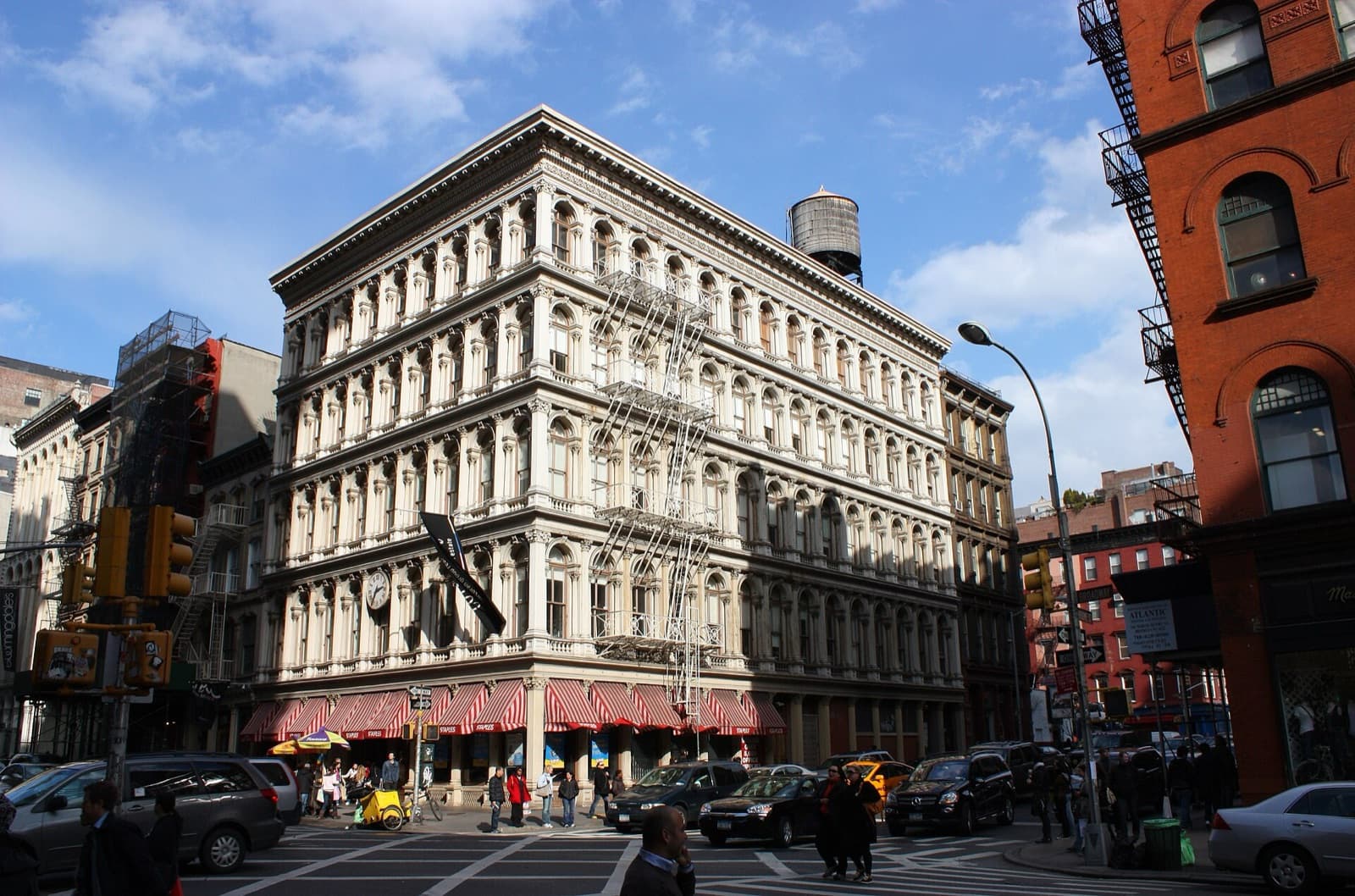
Cast iron is the thread running through it. The 1973 report explains that some buildings use cast-iron columns on the ground floor to hold up a traditional masonry front, while others have facades made entirely of iron. Iron parts could be cast in repeated patterns and bolted together, which is why so many SoHo fronts share the same rhythm of columns and tall, arched or square-headed windows. The report also notes that the earliest complete cast-iron facade in the district is the Haughwout Building of 1857, and that the next full cast-iron front there didn't appear until 1868.
From the bus's upper deck, look for the repeated columns, the deep cornices at the roofline and the fire escapes zigzagging down the fronts. From the sidewalk, look down: many buildings still have raised loading platforms and iron-and-glass vault lights set into the pavement, left over from the decades when these were warehouses and factories rather than boutiques.
The Haughwout Building: the one to find first
The E. V. Haughwout Building stands at 488–492 Broadway, at the corner of Broome Street, one block south of the stop. Built in 1857, it was the first store in New York with a passenger elevator designed expressly for customers, according to the city's landmark report.
Walk one block south on Broadway from Spring Street and the pale, palazzo-like corner building on your left at Broome Street is the Haughwout Building. The Landmarks Preservation Commission's designation report calls it one of the largest and handsomest of New York's cast-iron buildings, with two iron fronts and arched windows set between columns, a design the report compares to a Renaissance library in Venice. It was built for E. V. Haughwout's store, which sold cut glass, silverware, clocks and chandeliers.
Its bigger claim is the elevator. The Commission's report says it was the first store in New York to have a passenger elevator designed for the use of customers, and the SoHo Broadway Initiative, the neighborhood's business improvement district, credits Elisha Graves Otis with designing and installing that first commercial passenger elevator in the building. A cast-iron frame and a safe passenger elevator are two of the ingredients that later made skyscrapers possible, which is why this five-story store gets so much attention from architecture fans.
The building was designated an individual city landmark in 1965 and, according to the SoHo Broadway Initiative, added to the National Register of Historic Places in 1973. Today it has shops on the ground floor and private space above, so you're looking at it from the outside. The best view is from the northwest corner of Broadway and Broome, where you can see both facades at once. If you're riding rather than hopping off, have your camera ready as the bus approaches Broome Street.
A 60-to-90-minute walking loop from the stop
Walk south on Broadway to the Haughwout Building, west on Broome to Greene Street, north on Greene to Prince Street, then east on Prince back toward Broadway. Add Wooster Street and a gallery if you have more time.
This loop starts and ends near the bus stop and stays inside the cast-iron district the whole way. Nothing on it charges admission, and you can cut it short at any corner.
Start at Broadway and Spring and walk one block south to Broome Street for the Haughwout Building. Turn west on Broome and walk two short blocks to Greene Street. Greene is the street most people picture when they think of SoHo: a long, narrow canyon of iron fronts, fire escapes and shop windows between Canal and Houston. Turn north and walk it slowly, looking up as much as at the windows.
At Prince Street, turn right and head east back toward Broadway, passing more shops and cafés. If you have another half hour, detour one block west first to Wooster Street, a quieter parallel street that is home to the Drawing Center. From Prince and Broadway, the Prince St subway is right there, or walk back down Broadway to Spring for the bus.
Go early if you can. SoHo's sidewalks are narrow, and weekends and holiday-shopping afternoons get crowded, which slows the walk and makes photos harder. A mid-morning hop-off on a weekday is the easiest version of this loop.
- 1. Bus Stop 5 (Broadway & Spring) south one block to Broome St: the Haughwout Building at 488 Broadway.
- 2. West on Broome to Greene St.
- 3. North on Greene St to Prince St: the classic cast-iron canyon.
- 4. Optional: one block west to Wooster St for the Drawing Center (35 Wooster St).
- 5. East on Prince St back to Broadway: Prince St (R, W) subway or walk back to the bus stop.
Museums and galleries near the stop
The Drawing Center at 35 Wooster Street is free and open Wednesday to Sunday, noon to 6 p.m. The New York City Fire Museum at 278 Spring Street, further west, charges $15 for adults and is open Wednesday to Sunday, 10 a.m. to 5 p.m.
The Drawing Center, a museum devoted to drawing, is at 35 Wooster Street, a few blocks from the stop. Its visit page lists hours of Wednesday through Sunday, noon to 6 p.m., closed Monday and Tuesday, and free admission. It's a good 20-to-40-minute indoor stop and a calm break from Broadway's crowds.
The New York City Fire Museum is in a renovated 1904 firehouse at 278 Spring Street, between Varick and Hudson Streets in the Hudson Square district. That's a longer walk west along Spring Street, past Sixth Avenue, so allow extra time if you want to fit it in. The museum was closed from May 2024 over structural concerns and reopened on August 20, 2026, according to amNewYork. Its visitor information lists hours of Wednesday to Sunday, 10 a.m. to 5 p.m., and admission of $15 for adults, $10 for students, seniors 65 and over and people with disabilities, $6 for youth ages 3 to 17, and free for children 2 and under and for active FDNY, NYPD, PAPD and U.S. military with ID. It's a strong pick if you're traveling with kids.
Neither is included in a standard hop-on hop-off ticket. Check each museum's own site before you go, since hours and special closures change.
- The Drawing Center: 35 Wooster St. Free. Wed–Sun, noon–6 p.m.; closed Mon–Tue (checked Nov 1, 2026).
- New York City Fire Museum: 278 Spring St (Varick–Hudson). Adults $15; students/seniors 65+/visitors with disabilities $10; youth 3–17 $6; 2 and under free. Wed–Sun, 10 a.m.–5 p.m. (checked Nov 1, 2026).
Shopping, food and staying on schedule
SoHo is one of the city's big shopping districts, which is exactly why hop-offs here run long. Decide before you get off whether this is a one-hour architecture walk or a half-day shopping stop, and plan the rest of your downtown loop around that choice.
Broadway through SoHo is lined with large chain and flagship stores, while the side streets, especially Greene, Mercer, Wooster and Prince, have smaller boutiques and galleries. It's easy to lose an afternoon here, which is fine if that's the plan, but it means fewer downtown hop-offs later.
Food is everywhere and changes constantly, so we don't name restaurants or quote prices. A quick coffee or a takeaway lunch keeps you on schedule; a sit-down lunch is better saved for the next stop, Chinatown and Little Italy, which is about a 5-minute walk east and is covered in our Chinatown and Little Italy guide.
If you shop, think about the bus. Large bags are awkward on a crowded upper deck and on the stairs between decks. If you buy something big, it may be easier to carry it back to your hotel by subway and pick the bus up again later, or save shopping for the end of the day.
Keep your bus ticket on your phone with a screenshot in case your signal drops, and keep your phone in a front pocket in crowds. Our guide to buying NYC bus tour tickets safely explains how to avoid the street sellers who pitch tickets in Midtown.
Fitting SoHo into a downtown day
With buses every 30 minutes and a last full circuit leaving Times Square at 4:30 p.m., SoHo works best as a late-morning hop-off. Pair it with one bigger stop further downtown, like the 9/11 Memorial or the Brooklyn Bridge.
Big Bus's service information says the Downtown Loop leaves Stop 1, M&M's World at 7th Avenue and West 48th Street, at 9 a.m., the last full circuit leaves at 4:30 p.m., buses run every 30 minutes, and a full circuit takes about 90 minutes. SoHo is the fifth stop, so on an early ride you'll reach it mid-morning, when the sidewalks are quieter and the light on the cast-iron fronts is good for photos.
Big Bus's timetable for the next stop, Chinatown / Little Italy, lists its last bus at 5:10 p.m. SoHo comes just before it, so treat the last bus here as roughly 5 p.m. and confirm on the live timetable on the day. After that, the rest of the loop (the Brooklyn Bridge, Wall Street, the World Trade Center and the Hudson River side) is no longer reachable by bus.
A shape that works for most first-timers: board in Midtown around 9:30, ride past the Empire State Building and the Flatiron Building, hop off at SoHo for an hour, walk east to Little Italy and Chinatown for lunch, reboard at Stop 6, and choose one more downtown stop. If you'd rather not get off at all, SoHo is one of the better stretches to watch from the upper deck, since the bus runs right down Broadway through the district.
Remember that Big Bus's 30-minute frequency is a target, not a guarantee. Downtown traffic, especially on Broadway and around Canal Street, can slow buses. Our one-day NYC bus tour itinerary shows how to budget a full Downtown Loop day, and our downtown vs. uptown comparison explains what the other loop covers.
Compare current tour pricing
Prices and availability change by channel — check both before you book.
Frequently asked questions
Which hop-on hop-off stop is in SoHo?
Big Bus New York's Downtown Loop Stop 5, SoHo, at Broadway and Spring Street. Hoptripo's October 2026 stop guide lists the cast-iron blocks of Broadway, Prince Street and Greene Street nearby, with the Prince St (R, W) and Spring St (6) subways about 2 minutes away.
How long should I spend in SoHo on a bus tour?
About 60 to 90 minutes covers the Haughwout Building and a walk up Greene Street and back along Prince Street. Shoppers often stay longer; if you do, plan fewer hop-offs further downtown.
What is the cast-iron building in SoHo everyone photographs?
Usually the E. V. Haughwout Building at 488–492 Broadway, at Broome Street, one block south of the bus stop. Built in 1857, it was the first store in New York with a passenger elevator designed for customers, according to the Landmarks Preservation Commission.
Is SoHo walking distance from Chinatown and Little Italy?
Yes. Hoptripo puts Mulberry Street in Little Italy about 5 minutes' walk east of the SoHo stop, and the next bus stop, Chinatown / Little Italy, is at 100 Lafayette Street near Walker Street.
Are there free things to do in SoHo?
Most of SoHo is free: the cast-iron streets, the Haughwout Building's exterior and window-shopping. The Drawing Center at 35 Wooster Street lists free admission, Wednesday to Sunday, noon to 6 p.m.
Does the bus tour ticket include SoHo museums?
No. A standard hop-on hop-off ticket covers the bus only. The New York City Fire Museum at 278 Spring Street lists $15 adult admission on its own site; the Drawing Center is free.
Sources
- Hoptripo — Big Bus New York Downtown Loop stops (Stop 5 SoHo: Broadway, Prince St and Greene St; Mulberry St 5 min; Prince St R/W and Spring St 6 stations; data checked Oct 5, 2026)
- Big Bus Tours — New York service information (Downtown Loop first bus 9 a.m., last full circuit 4:30 p.m. from Stop 1, every 30 minutes, about 90-minute circuit)
- Big Bus Tours — Downtown Loop (Red Route) timetable (Stop 5 SoHo at Broadway & Spring St; Stop 6 last bus 17:10)
- NYC Landmarks Preservation Commission — SoHo-Cast Iron Historic District designation report (designated Aug. 14, 1973; 26 blocks, about 500 buildings; Haughwout Building the district's earliest full cast-iron facade)
- New York Preservation Archive Project — SoHo-Cast Iron Historic District (1973 designation, 2010 extension)
- NYC Landmarks Preservation Commission — E. V. Haughwout Building designation report LP-0017 (1857; first New York store with a customer passenger elevator)
- SoHo Broadway Initiative — A Look Back at SoHo's Broadway: The Haughwout Emporium (Otis elevator; 1965 landmark; 1973 National Register)
- Library of Congress — HABS NY-5459, E. V. Haughwout & Company Building, 488–492 Broadway
- The Drawing Center — Visit (35 Wooster St, hours, free admission)
- New York City Fire Museum — Visitor Information (278 Spring St, hours, admission)
- amNewYork — NYC Fire Museum reopens after two years of closure (reopening Aug. 20, 2026)
- Photo: "E.V. Haughwout Building" by Samuel.north, CC BY 3.0, via Wikimedia Commons (resized)
Related guides
The Flatiron Building and Madison Square Park on a NYC Bus Tour: The Stop, the Photo Spots and a One-Hour Hop-Off
Yes. Big Bus New York's Downtown Loop has a Flatiron District stop, Stop 4, between the Empire State Building / Koreatown stop and SoHo. Hoptripo's stop guide, checked October 5, 2026, puts the Flatiron Building, Madison Square Park and Eataly at the corner of Fifth Avenue and 23rd Street, all within a few minutes' walk, with the 23 St (R, W) subway at the corner. The Flatiron Building itself is being converted to apartments and has no visitor attraction inside, so this is an outdoor stop: photos of the building, a lap of Madison Square Park, and a snack. Allow about an hour before you reboard.
Chinatown and Little Italy on a NYC Bus Tour: The Stop, a Walking Loop, and What to Eat
Yes. Big Bus New York's Downtown Loop has a Chinatown / Little Italy stop, Stop 6, at 100 Lafayette Street near Walker Street. Big Bus's timetable lists the first bus there at 9:40 a.m. and the last at 5:10 p.m., with buses every 30 minutes. From the stop, Mott Street in Chinatown is about 4 minutes' walk east and Mulberry Street in Little Italy about 5 minutes north-east, according to Hoptripo's stop guide. The two neighborhoods sit side by side, so one hop-off of two to three hours covers a walking loop, a meal, and one small museum before you reboard.
Downtown Loop vs. Uptown Loop: Which NYC Bus Tour Route to Ride First
Ride Downtown first if this is your first visit — it covers the landmark corridor most first-timers came for: Times Square, the Empire State Building area, SoHo, Chinatown and Lower Manhattan. Ride Uptown first only if Central Park, the Upper West Side and Museum Mile are the actual reason for your trip. Most multi-day tickets include both loops, so the real question is sequencing, not choosing.
A One-Day NYC Bus Tour Itinerary That Actually Works
Board early and ride the full downtown loop first for orientation (roughly two hours), then spend the afternoon hopping off at two or three chosen stops — not more. Finish with Times Square on foot after dark. The plan fails when people try to hop off everywhere; the loop's value is seeing everything, the hop-offs' value is depth at a few places.
Get guides like this by email
Occasional, substantial, unsubscribe anytime.