Trinity Church and St. Paul's Chapel on a NYC Bus Tour: Nearest Stops, Hamilton's Grave and Hours
By the BusTourNYC editorial team · Published · Updated
Which hop-on hop-off stops serve Trinity Church and St. Paul's Chapel?
Hoptripo's stop guide for Big Bus New York's Downtown Loop (checked October 5, 2026) lists Trinity Church near Stop 8, Wall Street / Statue of Liberty, and Stop 9, Trinity Church, and lists St. Paul's Chapel within 5 minutes of Stop 10, World Trade Center. Trinity is at 89 Broadway and St. Paul's is at 209 Broadway. Trinity's own pages (checked November 4, 2026) list the church open 8:30 a.m. to 4 p.m. and St. Paul's open 8:30 a.m. to 6 p.m., with churchyards possibly closing at 4 p.m. and a security check at both. Plan 60 to 90 minutes for both.
Which bus stops serve Trinity Church and St. Paul's Chapel?
Both churches are on Broadway, a short walk apart, and both are served by Big Bus New York's Downtown Loop. Hoptripo lists Trinity Church near Stop 8 (Wall Street / Statue of Liberty) and Stop 9 (Trinity Church), and St. Paul's Chapel about 5 minutes from Stop 10 (World Trade Center).
Two churches belong to the same parish and sit a short walk apart on Broadway. Trinity Church is at 89 Broadway, at the head of Wall Street, and St. Paul's Chapel is at 209 Broadway, at Broadway and Fulton Street, according to Trinity's visitor pages. On the Downtown Loop you can reach both from stops that riders usually treat as stepping stones to other sights.
Hoptripo, an independent guide that checked Big Bus's stop list on October 5, 2026, lists three stops in this stretch. Stop 8, Wall Street / Statue of Liberty, has Trinity Church, the New York Stock Exchange and Federal Hall nearby. Stop 9 is named Trinity Church; Hoptripo says it is by Zuccotti Park and the back of Trinity Church, with the south pool of the 9/11 Memorial 4 minutes north. Stop 10, World Trade Center, has the Oculus, St. Paul's Chapel and the 9/11 Memorial pools within 5 minutes, with the One World Observatory entrance on West Street.
That means the natural way to see both is to walk from Trinity toward the World Trade Center site, or the reverse, rather than getting off and back on at every stop. Our Wall Street and Charging Bull guide covers the area around Stop 8, and our 9/11 Memorial guide covers Stop 10.
Hoptripo notes that stop positions are approximate and you should check the operator's map before you travel. Construction and street events in Lower Manhattan move stops, so use Big Bus's live map on the day you ride.
- Trinity Church: 89 Broadway at Wall Street. Hoptripo lists it near Stop 8 (Wall Street / Statue of Liberty) and Stop 9 (Trinity Church).
- St. Paul's Chapel: 209 Broadway at Fulton Street. Hoptripo lists it within 5 minutes of Stop 10 (World Trade Center).
- Subway (Hoptripo): Wall St (4, 5) at Stop 8; Cortlandt St (R, W) 2 minutes and WTC Cortlandt (1) 4 minutes from Stop 9; World Trade Center (E) at Stop 10.
Trinity Church: three buildings and 300 years on one corner
Trinity's own history says the first church was built on Wall Street in 1698 and burned in the Great Fire of 1776. The second, which opened in 1790, collapsed under heavy snow in 1839. The third, designed by Richard Upjohn and consecrated on Ascension Day 1846, is the one standing today.
Trinity Church's visit-and-history page gives the sequence plainly. A small group of Anglicans petitioned New York's royal governor, Benjamin Fletcher, for a charter, which he granted in 1697 on behalf of King William III. The first Trinity Church was erected on Wall Street in 1698. In 1705 Queen Anne made a land grant of 215 acres permanent, which the church used to support its work.
The first building was destroyed in the Great Fire of 1776 during the Revolutionary War. The second church opened in 1790, with a steeple that soared to 200 feet. George Washington, then President of the United States, attended the consecration, and he and members of his government worshiped there during the brief period New York City was the nation's capital. John Jay and Alexander Hamilton are named as notable parishioners from that era. In 1839, according to the parish, heavy snow made the roof's support beams collapse. British-born architect Richard Upjohn was asked to repair the church and decided to rebuild it completely.
The third church, consecrated on Ascension Day 1846, looks like a 14th-century English parish church. Trinity calls it one of the first and finest examples of Neo-Gothic architecture in the country and says its 281-foot steeple made it the tallest building in the United States for 23 years, and the tallest in New York City until 1890. The page also calls the sanctuary a National Historic Landmark. Today the parish describes itself as a community of over 1,600 members and says it funds a $6 billion endowment from the remaining land grant and investments. We repeat those as the church's own statements.
From the sidewalk the steeple is the thing to look up at, especially against the glass towers behind it. Inside, the sanctuary is the main sight. Trinity also offers augmented reality (AR) tours of its art, architecture and people buried in the churchyard, according to its visit page; we haven't tried them, so check the church's page for how they work.
The churchyard and Alexander Hamilton's grave
Trinity says its churchyard holds the graves of Alexander Hamilton, his wife Eliza and her sister Angelica Schuyler Church, plus a Soldiers' Monument for Revolutionary War soldiers thought to be buried there. The oldest legible gravestone is Richard Churcher's, from 1681. Trinity's pages disagree on the churchyard's closing time, so confirm it on the day.
The churchyard is the part of the site most visitors come for. Trinity's churchyard page says the ground was likely used as a public burial ground as early as the 1660s, when the Dutch controlled the city, which predates the church itself. The oldest legible gravestone, in the northeast section, belongs to five-year-old Richard Churcher, who died in 1681; beside him is the gravestone of Ann Churcher, buried in 1691.
The church's highlights list calls out the final resting places of Alexander Hamilton, the first U.S. Secretary of the Treasury, his wife Eliza, and her sister Angelica Schuyler Church. The Soldiers' Monument nearby honors Revolutionary War soldiers who were held in captivity in New York and are thought to be buried at Trinity. The burial ground was active from the 1660s to the 1820s, per the parish.
Two details matter for planning. First, entry requires a security and safety check, and Trinity says access may be restricted for weather or construction. Second, the church's pages give different closing times. Its main visit page, checked November 4, 2026, says the church is open 8:30 a.m. to 4 p.m. and the churchyard 8:30 a.m. to 6 p.m., while its churchyard page says the churchyard is open 8:30 a.m. to 4 p.m. Our Wall Street guide quotes an earlier posting of 8:30 a.m. to 6 p.m. Treat 4 p.m. as the safe time and arrive earlier in winter.
Trinity also lists specific closures on its visit page: the church closed at 4 p.m. on Wednesday, November 4; closes after the 11:15 a.m. service until 2:30 p.m. on Sunday, November 8; closes from 10 a.m. to 11:30 a.m. on Wednesday, November 11; and closes from 11 a.m. to 3:30 p.m. on Saturday, November 14. Those are the church's postings as of today and they change, so check the page before you go.
- Trinity Church, 89 Broadway: church 8:30 a.m.–4 p.m. daily; churchyard 8:30 a.m.–6 p.m. per the visit page but 8:30 a.m.–4 p.m. per the churchyard page (checked Nov 4, 2026).
- Security and safety check required; entry may be restricted for weather or construction.
- Buried in the churchyard: Alexander Hamilton, Eliza Hamilton, Angelica Schuyler Church (Trinity).
- Oldest legible gravestone: Richard Churcher, died 1681 (Trinity).
St. Paul's Chapel: Manhattan's only surviving colonial-era church
St. Paul's Chapel opened in 1766 and, per Trinity, is the only colonial-era church remaining in Manhattan and the oldest public building in continuous use in the borough. George Washington worshiped there on April 30, 1789, after taking the oath of office, and the chapel became a refuge for recovery workers after September 11.
Trinity's page for St. Paul's Chapel says it opened in 1766 as a chapel-of-ease for parishioners who didn't want to walk south to Trinity along unpaved streets. When the Great Fire of 1776 destroyed the first Trinity Church, St. Paul's survived, the page says, thanks to a bucket brigade that ran from the Hudson River up to the roof. Until the second Trinity Church was rebuilt in 1790, many people, including Washington, used St. Paul's as their spiritual home. On April 30, 1789, after taking the oath of office, Washington walked from Federal Hall on Wall Street to St. Paul's for services, according to the chapel's history.
The chapel's Broadway porch holds the Montgomery Monument, which the parish describes as believed to be the first Revolutionary War monument commissioned by the Continental Congress, by the French sculptor Jean Jacques Caffieri, in Pyrenees marble. The page says Brigadier General Richard Montgomery, who died in 1775 fighting in Quebec, is buried beneath it. Inside, the Glory altarpiece design was drawn by Pierre Charles L'Enfant, the architect of the plan for Washington, D.C. The statue of St. Paul that stood in an outdoor niche for more than 225 years was moved inside in 2016 and replaced with a resin replica.
The part visitors often come for is the chapel's role after the September 11, 2001 attacks. Trinity says St. Paul's, less than 100 yards from the World Trade Center, survived the destruction and then welcomed thousands of recovery workers over nine months, with volunteers providing food, supplies, counseling and prayer. The chapel displays items from that time, including a memorial pew, an iron cross forged from World Trade Center remnants, a chalice made of salvaged steel and a memorial altar where families posted notes for missing persons. Trinity says the chapel welcomes more than 1 million visitors every year.
That context shapes how to visit. It is an active church and a memorial space, not an attraction with a ticket line. Photography rules and what is on display change, so follow the signs and staff instructions.
Hours and closures for St. Paul's, and how to combine it with the 9/11 Memorial
Trinity's St. Paul's page (checked November 4, 2026) lists the chapel as open 8:30 a.m. to 6 p.m. and the churchyard 8:30 a.m. to 4 p.m., with a security check. It lists closures at 3 p.m. on Friday, November 6, and from 4:30 p.m. to 6 p.m. on Sunday, November 8.
The chapel is at 209 Broadway at Fulton Street. Trinity's St. Paul's page lists it open 8:30 a.m. to 6 p.m. and the churchyard 8:30 a.m. to 4 p.m., except when noted or when weather is hazardous, with a security and safety check required. Another Trinity page gives the St. Paul's churchyard hours as 8:30 a.m. to 6 p.m. daily. As with Trinity, the pages differ, so treat 4 p.m. as the cautious time for the churchyard and confirm before you travel.
Trinity's postings list the chapel closing at 3 p.m. on Friday, November 6, and closing from 4:30 p.m. to 6 p.m. on Sunday, November 8. We do not repeat future dates beyond those because the church updates them.
St. Paul's pairs well with the 9/11 Memorial and One World Observatory, both covered in our guides, because they are within a few minutes of each other. Hoptripo lists the 9/11 Memorial pools 5 minutes from Stop 10 and the One World Observatory entrance on West Street. The chapel's visit page lists no admission price, and Trinity says it hosts free concerts and cultural programs. A simple order is to ride to Stop 10, walk to St. Paul's and the memorial, then hop back on.
Timing against the bus matters. Big Bus says the Downtown Loop leaves Stop 1 at 9 a.m., buses run every 30 minutes, a full circuit takes about 90 minutes and the last full circuit leaves at 4:30 p.m. We quote those figures from Big Bus's service information as cited in our SoHo guide, and the page blocks automated access, so confirm with the operator. Because the churchyards may close at 4 p.m., plan the churches for the morning or early afternoon, not as a last stop.
- St. Paul's Chapel, 209 Broadway at Fulton St: open 8:30 a.m.–6 p.m.; churchyard 8:30 a.m.–4 p.m. per its page (another Trinity page says 6 p.m.).
- Closures posted Nov 4, 2026: Fri Nov 6 closes 3 p.m.; Sun Nov 8 closed 4:30–6 p.m.
- Free to enter; security and safety check required.
A 60-to-90-minute walk from Wall Street to the World Trade Center
Start at Trinity Church, walk north up Broadway to St. Paul's Chapel, then continue to the 9/11 Memorial pools and the Oculus. It is a straight line on Broadway with no admission fees, and Hoptripo lists the 9/11 Memorial pools and the Oculus within 5 minutes of Stop 10.
Take the bus to Stop 8 (Wall Street / Statue of Liberty) or Stop 9 and start at Trinity Church, which Hoptripo places next to those stops. Walk through the churchyard if it's open, look at Hamilton's grave and the Soldiers' Monument, and step into the sanctuary. Then walk north on Broadway to Fulton Street and St. Paul's Chapel at 209 Broadway.
From St. Paul's, Hoptripo lists the 9/11 Memorial pools and the Oculus within 5 minutes of the chapel, and Stop 10 (World Trade Center) is the place to reboard. If you want to go inside the memorial museum or up One World Observatory, add those to your plan separately; neither is included in a standard bus ticket. Our guides to the 9/11 Memorial and One World Observatory give details.
The more useful constraint is time. If you spend 20 minutes at each church and 30 minutes at the memorial, you have used about 90 minutes, which is a normal bus-loop interval.
Is it worth it? Who should skip it
Visit if you like history, architecture or the 9/11 story, you have 60 to 90 minutes in Lower Manhattan, and you're happy with a free, low-key visit. Skip it if you have only a few hours on the loop, if you need a long indoor attraction, or if you can't be at the churchyard before 4 p.m.
This is a good fit for a downtown hop-off because it is free, walkable from the bus and has real primary-source history: a 1698 Wall Street church that burned, a rebuilt Neo-Gothic church from 1846, and a 1766 chapel where Washington attended services. It is a poor fit if someone in your group wants a ticketed, interactive attraction, or if your plan is built around a ferry to the Statue of Liberty and not much else.
Accessibility and security: both sites require a security and safety check and may restrict entry for weather or construction, according to Trinity. We don't have step-free routes confirmed for the churchyards or sanctuaries, so ask the church before you travel. Our guide to wheelchair-accessible NYC bus tours covers the bus side.
Combining with other stops: if you only have time for two downtown hop-offs, pair this with the Wall Street area (our Wall Street guide covers Federal Hall, Fearless Girl and the Charging Bull) or the Brooklyn Bridge walkway. Our Downtown Loop versus Uptown Loop guide helps you pick which loop to ride, and our one-day itinerary shows how a full day fits together.
Compare current tour pricing
Prices and availability change by channel — check both before you book.
Frequently asked questions
Which hop-on hop-off stop is closest to Trinity Church?
Hoptripo's stop list, checked October 5, 2026, puts Trinity Church near Stop 8 (Wall Street / Statue of Liberty) and Stop 9 (Trinity Church), which it says is by Zuccotti Park and the back of Trinity Church. Trinity itself is at 89 Broadway at Wall Street.
How close is St. Paul's Chapel to the bus?
Hoptripo lists St. Paul's Chapel within 5 minutes of Stop 10 (World Trade Center). The chapel is at 209 Broadway at Fulton Street.
Is Alexander Hamilton buried at Trinity Church?
Yes. Trinity says the churchyard holds the graves of Alexander Hamilton, his wife Eliza and her sister Angelica Schuyler Church. Trinity's uptown cemetery at 601 West 153rd Street is a different site.
Is there an admission fee for Trinity Church or St. Paul's Chapel?
Neither church's visit page lists an admission price for general entry, and Trinity says St. Paul's hosts free concerts and cultural programs. A security and safety check is required at both. Check the pages for any program or tour that does charge.
What are the opening hours?
On November 4, 2026, Trinity's visit page lists the church open 8:30 a.m. to 4 p.m. and the churchyard 8:30 a.m. to 6 p.m., while its churchyard page lists 8:30 a.m. to 4 p.m. St. Paul's Chapel is listed 8:30 a.m. to 6 p.m. with its churchyard 8:30 a.m. to 4 p.m. Pages differ and closures change, so confirm before you travel.
Did St. Paul's Chapel survive September 11?
Trinity says St. Paul's, less than 100 yards from the World Trade Center, survived the destruction and afterward welcomed thousands of recovery workers for nine months. It displays items from that period.
Did George Washington really worship at St. Paul's?
Trinity's history says that on April 30, 1789, after taking the oath of office, Washington walked from Federal Hall on Wall Street to St. Paul's Chapel and attended services. It also says he and his government worshiped at the second Trinity Church after it opened in 1790.
Is St. Paul's Chapel really the oldest building in Manhattan?
Trinity's wording is narrower: St. Paul's is the only colonial-era church remaining in Manhattan and the oldest public building in continuous use in the borough. We repeat the church's own claim.
Sources
- Hoptripo — Big Bus New York Downtown Loop stops (Stops 8, 9, 10 nearby sights, subway stations; data checked Oct 5, 2026)
- Trinity Church — Trinity Church: A Historic House of Worship (address, hours, posted closures, history 1697–1846, Neo-Gothic, Hamilton, endowment; checked Nov 4, 2026)
- Trinity Church — St. Paul's Chapel (209 Broadway, hours, closures, 1766 history, Washington April 30, 1789, Montgomery Monument, 9/11 ministry; checked Nov 4, 2026)
- Trinity Church — Cemetery & Churchyards (Trinity Churchyard history, Churcher gravestone 1681, Hamilton graves, Soldiers' Monument, St. Paul's churchyard hours; checked Nov 4, 2026)
- Big Bus Tours — New York service information (Downtown Loop first bus 9 a.m. from Stop 1, last full circuit 4:30 p.m., every 30 minutes, about 90-minute circuit; as cited in our SoHo guide Nov 1, 2026; page blocked automated access)
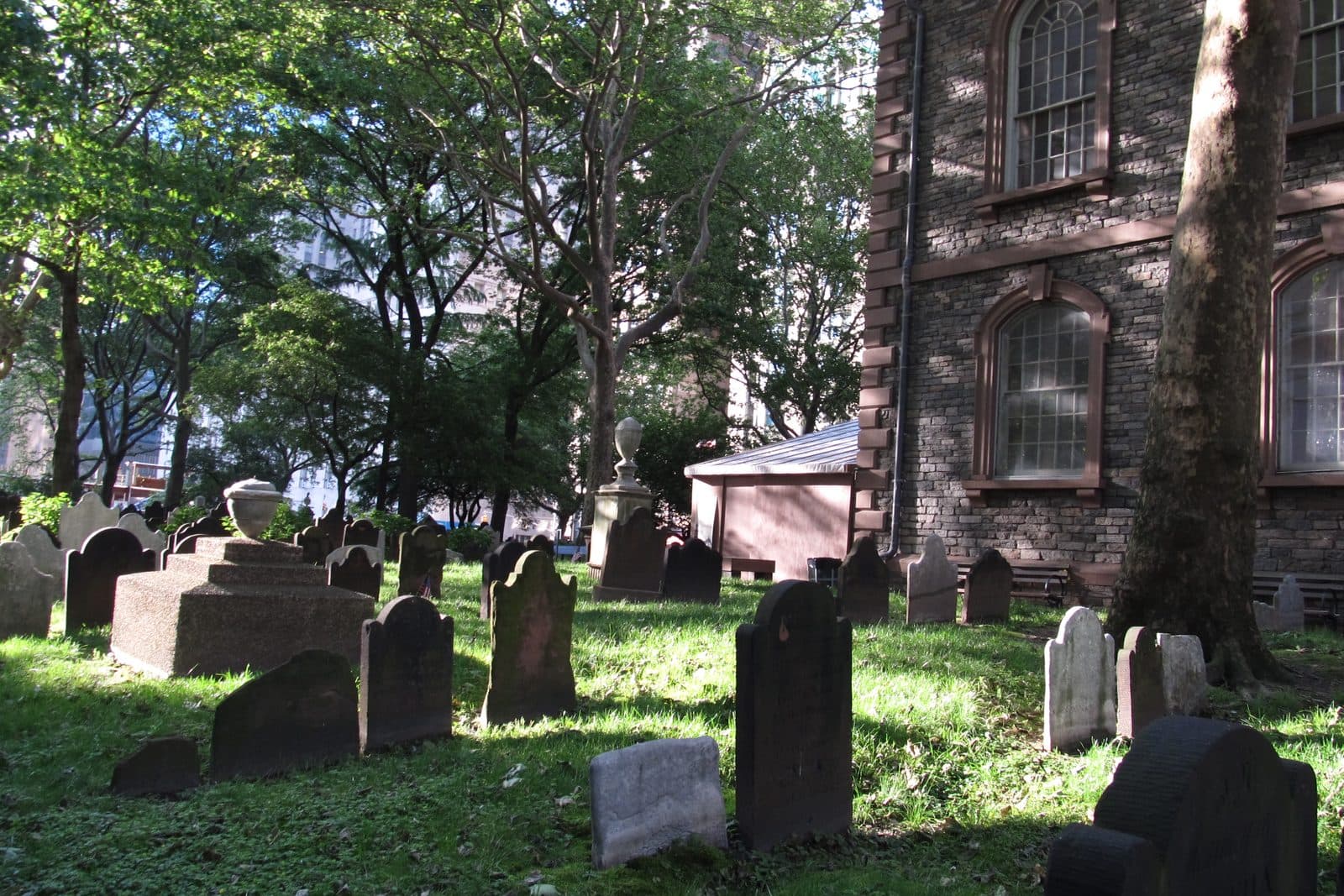
- Photo: "St. Paul's Chapel, Manhattan, New York (7237167486).jpg" by Ken Lund, CC BY-SA 2.0, via Wikimedia Commons (resized and cropped)
Related guides
Wall Street and the Charging Bull on a NYC Bus Tour: Stop, What's Free, and What You Can't Go Inside
Yes, but the good part is on foot. Big Bus New York's Downtown Loop stops at Wall Street / Statue of Liberty, listed on its route map at Broadway and Wall Street, southwest corner near Rector Street. From there Trinity Church is across the street, Federal Hall and the New York Stock Exchange are a short walk east along Wall Street, and Hoptripo's October 2026 stop guide puts the Charging Bull about 4 minutes south. Everything in that loop is free to see. The NYSE itself has no public tours, so you photograph it from Broad Street. Federal Hall is the one building on Wall Street you can walk into, free, Wednesday to Sunday from 10 a.m. to 4 p.m. per the National Park Service.
9/11 Memorial & NYC Bus Tours: What's Actually Included
No, and this one has an extra wrinkle: the outdoor Memorial plaza with the twin reflecting pools is free and open to the public year-round without any ticket, bus or otherwise — but the indoor Museum requires a separate, timed-entry paid ticket that no hop-on hop-off fare includes. Downtown loops stop near the site; getting into the museum itself is always its own purchase.
One World Observatory & NYC Bus Tours: What's Actually Included
No. Downtown hop-on hop-off loops run through the Financial District near One World Trade Center, but that's proximity, not admission — riding past the tallest building in the Western Hemisphere doesn't put you inside it. One World Observatory, spanning floors 100 through 102, is always a separate ticket bought directly from the observatory, never bundled into a standard bus fare.
Downtown Loop vs. Uptown Loop: Which NYC Bus Tour Route to Ride First
Ride Downtown first if this is your first visit — it covers the landmark corridor most first-timers came for: Times Square, the Empire State Building area, SoHo, Chinatown and Lower Manhattan. Ride Uptown first only if Central Park, the Upper West Side and Museum Mile are the actual reason for your trip. Most multi-day tickets include both loops, so the real question is sequencing, not choosing.
Wheelchair and Mobility Accessible NYC Bus Tours: What's Actually Verified
Big Bus publishes the clearest wheelchair policy among the major NYC operators: a stated fully-accessible fleet with lifts rated to 650 pounds, though the open upper deck — the actual scenic-view product — may not be reachable, and accommodations need 48 hours' notice. TopView describes its buses as accessible but we could not find an equivalent official fleet-wide policy page; call ahead and confirm the vehicle assigned to your date. Neither operator's lift replaces a fully planned accessible day — it gets you on board, not up the stairs to the view you're paying for.
A One-Day NYC Bus Tour Itinerary That Actually Works
Board early and ride the full downtown loop first for orientation (roughly two hours), then spend the afternoon hopping off at two or three chosen stops — not more. Finish with Times Square on foot after dark. The plan fails when people try to hop off everywhere; the loop's value is seeing everything, the hop-offs' value is depth at a few places.
Get guides like this by email
Occasional, substantial, unsubscribe anytime.